Personalis Announces New Publication Advancing Neoadjuvant Treatment Monitoring in Breast Cancer with NeXT Personal®

Personalis Announces New Publication Advancing Neoadjuvant Treatment Monitoring in Breast Cancer with NeXT Personal®


Personalis Announces New Publication Advancing Neoadjuvant Treatment Monitoring in Breast Cancer with NeXT Personal®

FREMONT, Calif.–(BUSINESS WIRE)–Personalis, Inc. (Nasdaq: PSNL), a leader in advanced genomics for precision oncology, today announced the publication of the PREDICT-DNA study in the Journal of Clinical Oncology. The article, “The Pathologic Response Evaluation and Detection In Circulating Tumor-DNA (PREDICT-DNA) study: Ultrasensitive ctDNA Assessment of Breast Cancer Minimal Residual Disease,” showed that ultrasensitive molecular residual disease (MRD) testing with NeXT Personal can perform better than current standard approaches in predicting patient outcomes following neoadjuvant therapy (NAT).


The prospective study followed 227 patients with Triple-Negative (TNBC) and HER2+ breast cancer across more than 24 leading US cancer centers. The results demonstrate the ability of NeXT Personal to provide a more precise risk-stratification for patients who have received NAT.

A key finding of the study was the necessity of the ultrasensitive range for accurately tracking patient response to neoadjuvant therapy. Of note, 55% of all ctDNA detections following NAT occurred at levels below 100 parts per million, detections that could be missed with less sensitive tests.

“Many breast cancer patients receive neoadjuvant therapy as standard of care, prior to surgery. The results of this study suggest that an ultrasensitive ctDNA assay like NeXT Personal could help patients better understand their response to neoadjuvant therapy, with the potential to help inform the need for additional therapy,” said Richard Chen, MD, Chief Medical Officer and Executive Vice President, R&D at Personalis. “The publication of this data is important as we look to expand reimbursement and improve the tools used in neoadjuvant monitoring.”

Key study highlights include:

  • High Prognostic Power: Detectable ctDNA post-NAT was associated with a 4 to 9 times higher likelihood of relapse.
  • Superior to Traditional Metrics: In multivariate analyses, ctDNA status was the most significant independent prognostic signal, performing better than nodal status, tumor grade, and pathologic complete response (pCR) status. In addition, ctDNA detection post-NAT was a stronger predictor of recurrence than pCR status.
  • Identification of Low Risk: Patients who were ctDNA-negative post-NAT showed excellent outcomes, regardless of pCR status.
  • Post-Surgical Relapse Prediction: Patients with detectable ctDNA up to 12 months post-surgery were more than 100 times more likely to experience disease recurrence.

“We partnered with Personalis because their technology offers a level of sensitivity down to 1 to 3 parts per million that allows for a higher cancer detection rate,” said Dr. Ben Park, MD, PhD, Director of the Vanderbilt-Ingram Cancer Center. “The PREDICT-DNA results show that if a patient clears their ctDNA, their outcomes are excellent even if residual disease is found at surgery. Conversely, detectable ctDNA signals a very high risk. These insights allow us to more precisely risk-stratify breast cancer patients in future trials and clinical practice.”

The findings reinforce the NeXT Personal test’s ability to detect ctDNA at ultrasensitive levels, providing a window for earlier clinical intervention that other approaches may miss. The NeXT Personal test achieves ultrasensitive detection of small traces of ctDNA from a patient’s blood sample using a personalized approach that tracks up to ~1,800 tumor-specific variants unique to each patient’s tumor.

About Personalis, Inc.

At Personalis, we are transforming the active management of cancer through breakthrough personalized testing. We aim to drive a new paradigm for cancer management, guiding care throughout the patient journey. Our highly sensitive assays combine tumor-and-normal profiling with proprietary algorithms to deliver advanced insights even as cancer evolves over time. Our products are designed to detect minimal residual disease (MRD) and recurrence at the earliest timepoints, enable selection of targeted therapies based on ultra-comprehensive genomic profiling, and enhance biomarker strategy for drug development. Personalis is based in Fremont, California. To learn more, visit www.personalis.com and connect with us on LinkedIn and X (Twitter).

Forward-Looking Statements

This press release contains forward-looking statements within the meaning of the Private Securities Litigation Reform Act of 1995. Forward-looking statements include all statements that are not historical facts, including statements relating to the attributes, advantages, sensitivity, and clinical relevance (including prognostic power, risk-stratification capabilities and superiority to traditional metrics) of the NeXT Personal test and the potential impact or expected benefits of the PREDICT-DNA study. Such forward-looking statements involve known and unknown risks and uncertainties and other factors that may cause actual results to differ materially from any anticipated results or expectations expressed or implied by such statements, including the risks, uncertainties and other factors that relate to Personalis’ ability to demonstrate attributes, advantages or clinical validity or utility of the NeXT Personal test, including the NeXT Personal MRD assay remaining unique in its ability to detect traces of cancer in the ultrasensitive range; future clinical data differing from the clinical data previously presented or expected results; the ability of Personalis to expand reimbursement for, or the rate of adoption and use of, the NeXT Personal test; changes in health care policy, which could increase Personalis’ costs, decrease Personalis’ revenue, and impact sales of and reimbursement for Personalis’ tests; the impact of competition and macroeconomic factors on Personalis’ business; the partnering and/or collaboration arrangements that Personalis has entered into or may enter into in the future, which may not be successful, or may terminate, which could adversely impact Personalis’ business or affect its ability to develop and commercialize its services and products; having a limited number of suppliers; and customer concentration. These and other potential risks and uncertainties that could cause actual results to differ materially from the results predicted in these forward-looking statements are described under the captions “Risk Factors” and “Management’s Discussion and Analysis of Financial Condition and Results of Operations” in Personalis’ Annual Report on Form 10-K for the year ended December 31, 2025, filed with the Securities and Exchange Commission (SEC) on February 26, 2026. All information provided in this release is as of the date of this press release, and any forward-looking statements contained herein are based on assumptions that we believe to be reasonable as of this date. Undue reliance should not be placed on the forward-looking statements in this press release, which are based on information available to us on the date hereof. Personalis undertakes no duty to update this information unless required by law.

Contacts

Investor Relations:
Caroline Corner

investors@personalis.com
415-202-5678

Media Contact:
Patrick Schmidt

pr@personalis.com
630-290-2787

Combat Medical Raises £2.6 Million Series A to Advance Treatment of BCG Unresponsive Bladder Cancer

Combat Medical Raises £2.6 Million Series A to Advance Treatment of BCG Unresponsive Bladder Cancer


Combat Medical Raises £2.6 Million Series A to Advance Treatment of BCG Unresponsive Bladder Cancer

  • Investment led by T&J Meyer Family Foundation, joined by Varia Ventures, NW Angel Fund and other non-institutional investors
  • Financing advances Combat’s HIVEC® HEAT FDA registration trial to change standard of care in BCG unresponsive NMIBC
  • Future financings to progress patented hyperthermic technology aimed at improving chemotherapy therapeutic efficacy, tolerability and treatment outcomes for advanced bladder and peritoneal cancers

LONDON–(BUSINESS WIRE)–Combat Medical (Combat), a medical device company optimising the delivery and efficacy of cancer therapeutics, today announced it has raised £2.6 million in the first close of a Series A financing to advance its hyperthermic intravesical chemotherapy treatment, HIVEC®, through phase 3 clinical trials and toward FDA registration. The round was led by T&J Meyer Family Foundation, and included investment from Varia Ventures, NW Angel Fund and non-institutional family offices and individuals.


The funding will be used to further fund the ongoing pivotal FDA registration trial, HIVEC HEAT, to investigate the effectiveness of the Company’s HIVEC treatment of BCG unresponsive non-muscle-invasive bladder cancer (NMIBC). The primary objective is to generate phase 3 clinical data to evidence Combat’s patented HIVEC treatment as an effective, safe and tolerable alternative to the current standard of care, which is radical cystectomy.

Combat will use future financings to complete FDA registration, growing operations to scale, expanding its existing clinical programmes for advanced bladder cancer (HIVEC) and peritoneal cancer (HIPEC), with a focus on US market entry.

Edward Bruce-White, Chief Executive Officer of Combat Medical, commented: “Our installed base of over 350 systems and the completion of over 100,000 HIVEC treatments to date demonstrates efficacy and use as a safe and well-tolerated, bladder-sparing alternative to radical cystectomy in BCG-unresponsive, high-risk NMIBC. Setting a new standard for patient care, it also provides clinicians and payers with advanced, affordable options that can easily be built into current treatment pathways. We are proud to have our investors on board as we progress through to FDA approval.”

Balint Nemeth, T&J Meyer Family Foundation, added: “Combat Medical is leading the development and clinical use of device assisted therapies with potential to disrupt current treatment standards. With systems in wide clinical use and already impacting patient outcomes, we are excited to support the company as HIVEC progresses through clinical trials.”

Contacts

Media contacts:
Sarah Jeffery

Zyme Communications

Tel: +44 (0) 7771 730919

Email: sarah.jeffery@zymecommunications.com

Consultation process at Bichsel completed

On 24 February 2026, Galenica announced its intention to discontinue pharmaceutical production at its subsidiary Bichsel at the end of 2026 for economic reasons and to focus its business on home care services. Bichsel has now completed the consultation process that was initiated as part of this announcement. The Board of Directors and the Executive Committee have carefully reviewed the proposals submitted by the employee representatives during the consultation process. However, the process confirmed that production has been in deficit for years and that the existing facilities and buildings cannot be maintained despite continuous investments in recent years. As a result, continued operation is not economically viable under any scenario. The Board of Directors has therefore decided to close the production division at the end of 2026.

Comprehensive social plan

The originally anticipated reduction of 170 jobs can be reduced slightly by 18 jobs and now affects 152 jobs. In addition, an evaluation will be carried out over the coming weeks to determine how many employees can be employed within the Galenica network. Employees will be informed of their personal situation in the coming days. All affected employees will be supported by a comprehensive social plan. Among other things, the plan takes into account the age and years of service and includes provisions for cases of hardship. In addition, the affected employees will be supported in finding new employment. The constructive proposals submitted by the employee representatives have been incorporated into the social plan and have made a significant contribution to its design.

Supporting customers

Bichsel is in close contact with its customers and will support them during the transition phase as well as the search for alternative suppliers. Production will be continued and planned until the mid-year in such a way that Bichsel will be able to supply its customers with the most important products until approximately the end of the year. The extemporaneous formulations business will be taken over by the Galenica company Laboratoire Golaz in Lausanne. These products are particularly important for doctors and their patients and are sold through pharmacies.

SK pharmteco Announces CGMP Qualification of its Commercial-Scale Viral Vector Manufacturing Facility in France

SK pharmteco Announces CGMP Qualification of its Commercial-Scale Viral Vector Manufacturing Facility in France


SK pharmteco Announces CGMP Qualification of its Commercial-Scale Viral Vector Manufacturing Facility in France

RANCHO CORDOVA, Calif., March 12, 2026 (GLOBE NEWSWIRE) — SK pharmteco today announced the successful CGMP qualification of its manufacturing facility in Corbeil-Essonnes, France. This state-of-the-art plant is now fully operational and prepared to support late-stage and commercial viral vector programs at scale.

Recently, the facility was inspected by the ANSM (French Health Authority) and was successfully approved for operations. It has since produced its first batch using the company’s proprietary AAVelocity™ platform, a cornerstone of SK pharmteco’s extensive history in viral vector manufacturing.

“The qualification of this new facility marks a crucial milestone for SK pharmteco and our partners,” said Joerg Ahlgrimm, CEO of SK pharmteco. “By providing a fully inspected and approved environment that mirrors our development workflows, we eliminate the traditional ‘readiness gap.’ Our clients can now scale from preclinical stages to commercial supply with the same teams, the same platforms, and the same systems, ensuring total continuity and faster speed-to-market.”

Bridging the Gap from Clinical to Commercial
The new infrastructure is specifically designed for reproducibility and scale, offering:

  • Two multiproduct and independent manufacturing facilities
  • Two independent viral vector production suites
  • 5,000 m² purpose-built CGMP facility designed for scalable viral vector manufacturing
  • 12 single-use bioreactors from 50 L to 1,000 L providing a total installed upstream capacity of 5,000 L
  • Capacity for up to 40 cGMP batches per year, supporting parallel processing and reliable supply

By leveraging its established platforms, AAVelocity™ and LentiSure™, SK pharmteco ensures that processes running at a clinical scale remain reliable and steady when scaled up to larger commercial volumes, greatly reducing the risks for cell and gene therapy developers.

Additionally, the expansion directly addresses the critical pain points currently facing the viral vector market, including:

  • Regulatory Confidence: After inspection and approval by health authorities, the facility meets the highest standards of CGMP compliance.
  • Operational Continuity: Clients no longer need to switch CDMOs during scale-up, preventing delays, knowledge loss, and comparability risks related to tech transfers.

When combined with SK pharmteco’s other gene therapy manufacturing location outside of Philadelphia, this expansion enhances SK Pharmteco’s role as a leading global partner in viral vector manufacturing.

About SK pharmteco
SK pharmteco is a global contract development and manufacturing organization (CDMO) with production sites, research & development facilities, and analytical laboratories across the U.S., Europe, and South Korea. The company’s core capabilities center on small molecules, peptides, and viral vectors, providing the specialized expertise needed to bring complex therapies to market. Through these pillars, SK pharmteco supports biopharmaceutical partners of all sizes with comprehensive development and manufacturing solutions worldwide. SK pharmteco is a subsidiary of SK Inc. (SK), the strategic investment company for SK Group, South Korea’s second-largest conglomerate. 

Contact:
Keith Bowermaster, APR, CCMP
Communications Consultant
keith.bowermaster@skpt.com

Aplagon Announces First Patient Dosed in Phase 2a Clinical Trial of APAC in Patients with Peripheral Arterial Occlusive Disease / Chronic Limb Threatening Ischemia

Aplagon Announces First Patient Dosed in Phase 2a Clinical Trial of APAC in Patients with Peripheral Arterial Occlusive Disease / Chronic Limb Threatening Ischemia


Aplagon Announces First Patient Dosed in Phase 2a Clinical Trial of APAC in Patients with Peripheral Arterial Occlusive Disease / Chronic Limb Threatening Ischemia

HELSINKI, March 12, 2026 (GLOBE NEWSWIRE) — Aplagon, a clinical stage biotech pioneering a first-in-class treatment for thrombo-inflammatory diseases, known as APAC, a heparin proteoglycan mimetic with antiplatelet and anticoagulant effects, announced today the first patient has been dosed in its Phase 2a ‘HEALING’ clinical trial in peripheral arterial occlusive disease (PAOD) leading to chronic limb threatening ischemia (CLTI).

The single- and repeat- dose study using an intravenous (IV) administration taking place in Finland, is for up to 42 patients across 4 cohorts and has been designed to provide a preliminary indication of safety and efficacy of APAC in CLTI patients (with and without revascularisation) as well as APAC’s effect on thrombo-inflammatory biomarkers. Atherosclerosis-related thrombo-inflammation lead to CLTI, a severe form of PAOD, with insufficient blood flow in the affected limb, which can indicate limb amputation and has a mortality rate of 25% in the first year. The most important risk factors are diabetes and cigarette smoking.

This new Phase 2a trial received FIMEA approval following the successful completion of an international Phase 1 clinical trial in 30 healthy participants, which demonstrated that APAC was well tolerated, with dose-dependent and transient systemic antithrombotic effects. An associated PET-imaging clinical trial with 89zirconium-labeled APAC in PAOD patients and healthy participants is due to complete in H1 2026.

Aki Prihti, CEO at Aplagon, said, “We’re delighted to have achieved this significant clinical milestone and dosed our first patient in our Phase 2a trial to treat PAOD/CLTI. These are common, serious, thrombo-inflammatory diseases with high morbidity. Our innovative approach, using a heparin proteoglycan mimetic with targeting ability and retention on the vascular injury sites, has potential applications across a broad range of serious vascular diseases caused by thrombo-inflammation. Importantly, our APAC technology can be easily administered locally or intravenously in the hospital setting, supporting its uptake by vascular surgeons or angiologists.”

Maarit Venermo, Professor of vascular surgery, MD, PhD at Helsinki University Hospital, University of Helsinki, commented on the study, “The aim of this study is to improve the current treatment of PAOD/CLTI. APAC has been shown to prevent platelet aggregation and blood clotting. Previous studies have also shown that it reduces the inflammatory response in tissues damaged by oxygen deprivation during short follow-ups. Through these actions, APAC enhances the medical treatment of lower limb arterial atherosclerosis, accelerate the healing of tissue damage caused by ischemia, and prevent restenosis after revascularization procedures, thereby reducing the need for reinterventions.”

PAOD is relatively common and, as it progresses, can lead to limb threatening ischemia, significantly increasing the risk of amputation if arterial perfusion is not improved by a revascularization procedure. Arterial occlusions are often caused by atherosclerotic plaque formation, which may be aggravated by platelet aggregation at sites of severe stenosis, worsening limb ischemia. Current treatments for PAOD do not cure the disease but only alleviate symptoms. Revascularization procedures are often effective; however, particularly after endovascular treatment, restenosis occurs in approximately one-third of treated arteries, even when patients are on antithrombotic medication according to current treatment guidelines. The occurrence of restenosis and microvascular dysfunction represent a significant Achilles’ heel of endovascular treatment, leading to not only suffering for patients but also considerable societal costs.

Aplagon is also planning for 2026 a Phase 2 clinical trial for arteriovenous fistula (AVF) maturation failure in Europe, following the successful completion of its Phase 1 AVF trial. The study demonstrated encouraging early maturation results with no safety concerns.

About Aplagon Oy

Aplagon is a clinical stage biotech company developing a first-in-class therapeutic, called APAC (anti-platelet and anticoagulant), for treating thrombo-inflammatory diseases. The company’s two lead indications are for the prevention of arteriovenous fistula (AVF) maturation failure, to enable lifesaving haemodialysis treatment in end-stage kidney disease patients, and for chronic limb threatening ischemia (CLTI). By mimicking naturally occurring mast cell-derived heparin proteoglycans, APAC targets arterial injury sites providing long-lasting antithrombotic and anti-inflammatory action in situ. APAC is intended for in-hospital use and can be administered either locally or by IV infusion.

APAC is based on the pioneering research on mast cell-derived heparin proteoglycans performed by Prof. Riitta Lassila and associates at Wihuri Research Institute in Helsinki, Finland. Aplagon is backed by a syndicate of leading Nordic investors including FSG Fund, Wihuri Foundation, Innovestor and Serlachius Foundation as well as EIC Fund. The company is headquartered in Helsinki, Finland.

For more information see our website and LinkedIn.

Media Contacts

Aplagon

Aki Prihti, CEO
aki.prihti@aplagon.com

Scius Communications
Katja Stout +44 7789435990
katja@sciuscommunications.com

Daniel Gooch +44 7747875479
daniel@sciuscommunications.com

Cbio A/S Receives European Regulatory Clearance to Begin First-in-Human Clinical Trial of Next-Generation T-Cell Therapy in late-stage Cervical Cancer

Cbio A/S Receives European Regulatory Clearance to Begin First-in-Human Clinical Trial of Next-Generation T-Cell Therapy in late-stage Cervical Cancer


Cbio A/S Receives European Regulatory Clearance to Begin First-in-Human Clinical Trial of Next-Generation T-Cell Therapy in late-stage Cervical Cancer

COPENHAGEN, Denmark, March 12, 2026 (GLOBE NEWSWIRE) — Cbio A/S today announced that it has received regulatory clearance to begin a first-in-human Phase I/IIa clinical trial of novoleucel, the company’s next-generation T-cell therapy designed to improve immune cell function in cancer patients potentially leading to a more effective treatment.

The study will enroll up to 20 patients with persistent or recurrent cervical cancer at Karolinska University Hospital in Stockholm, with the first patients expected to be treated within the coming months. Initial safety and translational data are expected by the end of 2026.

The milestone marks Cbio’s transition into clinical development and represents a key value inflection point for the company as it advances its strategy to improve the effectiveness of cell-based therapies in solid tumors.

“The regulatory clearance marks a defining milestone for Cbio,” said Ulrik Cordes, Founder and CEO of Cbio. “Patients with recurrent cervical cancer have very limited treatment options once standard therapies fail. We believe that novoleucel has the potential to significantly transform the treatment landscape and are excited to begin evaluating this novel approach in patients.”

Cervical cancer remains a major global health challenge, with more than 660,000 new cases diagnosed and 349,000 dying annually worldwide. The new cell-based therapy addresses a high unmet medical need for more effective treatment options.

Novoleucel is a first-in-class therapy designed to address the central challenge in cancer immunotherapy: oxidative stress within the tumor microenvironment that disables immune cells and limits therapeutic efficacy. The T-cells are armored to cope with this stress, increasing resistance to reactive oxygen species and helping preserve their cancer-killing activity inside tumors.

The therapy is based on discoveries from Professor Rolf Kiessling and Stina Wickström’s research group at Karolinska Institute, pioneers in adoptive cell therapy.

“For many years we have studied how oxidative stress suppresses immune cells in tumors,” said Rolf Kiessling. “By protecting tumor-reactive T-cells through activation of the Nrf-2 pathway, we aim to improve their persistence and anti-tumor activity. It is very gratifying to see this concept now entering clinical testing.”

The therapy will be manufactured at Cbio’s in-house GMP-certified cell therapy production facility in Copenhagen, Denmark, a 1,000 m² production facility dedicated to clinical-grade cell therapy manufacturing.

Cbio is supported by a syndicate of Nordic and international investors and is raising additional capital to support the expansion of the Phase I/IIa clinical program and to further develop its broader cell therapy platform.

“Seeing the program now enter clinical testing is both a proud moment and an important step forward for patients,” said Cecilia Hultén, Co-Founder and CFO in Cbio. “The start of the clinical program represents an important value inflection point for the company,” said Christian Leroy, board member and investor in Cbio. “We believe Cbio is advancing a compelling approach to improving cell therapies for solid tumors and look forward to following the development of novoleucel.”

The ongoing financing will support expansion of the clinical program and the generation of initial safety and translational data expected by the end of 2026.

About the Clinical Trial (EUCT 2024-517594-24)

The Phase I/IIa study will evaluate novoleucel in patients with persistent or recurrent cervical cancer who have progressed after platinum-based chemotherapy and checkpoint inhibitors. The trial will assess safety, feasibility of manufacturing and delivery, persistence of infused T-cells, and early signals of clinical activity.

About Cbio

Cbio A/S is a Nordic biotechnology company developing next-generation cell therapies for solid tumors based on discoveries from the Karolinska Institute, Sweden. The Company operates from Copenhagen and has own production facility for immune cell therapies.

Investor and Media Contact

Cbio A/S
Ulrik Cordes, CEO
ucordes@cbio.dk
+45 31 62 53 33
www.cbio.dk

A photo accompanying this announcement is available at https://www.globenewswire.com/NewsRoom/AttachmentNg/a0865d7f-1ea0-4262-80e5-0385fd4e01f1

Allegro’s osteoarthritis hydrogel resolves lameness in animal study

Allegro’s osteoarthritis hydrogel resolves lameness in animal study


Allegro’s osteoarthritis hydrogel resolves lameness in animal study

  • The hydrogel resolved lameness in 72% of horses treated
  • Horses provide a strong translational model for human osteoarthritis
  • Clinical investigation authorized by Belgian regulatory authority
  • Allegro’s hydrogel is first-in-class potentially disease-modifying osteoarthritis device candidate

Liege, Belgium – 12 March 2026 (08:30 CET) – Allegro NV, a biomedical company developing transformative nanotechnology treatments for degenerative joint disease, has demonstrated that its proprietary injectable hydrogel significantly improved joint mobility in horses with osteoarthritis. In a proof-of-concept study in 40 mature thoroughbred horses with osteoarthritis, 89.6% showed a reduction in lameness after the treatment, while 72.4% demonstrated complete resolution of lameness four weeks later. Allegro plans to publish the results of the study at a leading medical conference in 2026.

The company is also announcing today it has received approval from the Federal Agency for Medicines and Health Products (FAMHP) in Belgium for an open-label feasibility study with its Hydrocelin hydrogel device candidate in 20 patients with osteoarthritis of the knee. Allegro expects to launch the study in the coming weeks.

“These first efficacy results in horses using Allegro’s osteoarthritis treatment candidate suggest extraordinary promise for use in humans. Osteoarthritis is the leading cause of disability in humans, with no disease-modifying treatment available today. At Allegro, we’re working to demonstrate benefits to patients in our clinical testing this year, and offer better outcomes for the 650 million people affected by the disease,” said Lucas Decuypere, CEO of Allegro.

Horses are a strong translational model for humans in joint disease and Allegro is fully focused on the clinical development of its technology, after signing an exclusive licensing deal for its technology for use in veterinary markets with American Regent, a leading pharmaceutical company in the U.S. specializing in injectables for human and animal health. Allegro will supply American Regent with product from its manufacturing site in Belgium.

In the study, horses received a single injection of the hydrogel in the most affected joint, and hyaluronic acid (Optivisc Single) in the contralateral (healthy) joint as a control.

Among the findings were:

  • After four weeks of treatment with Allegro’s hydrogel, 89.6% of horses (26 out of 29 evaluable horses) showed improvement of the AAEP lameness score, while 72.4% (21 out of 29 evaluable horses) showed complete resolution of lameness.
  • The difference in the AAEP lameness score after 4 weeks of treatment compared with the score before treatment was statistically significant (p<0.05).
  • No adverse effects were observed in pathological joints after the nanogel injection and throughout the 4-week follow-up period.

Hydrocelin contains cross-linked particles designed to act as tiny shock absorbers in the synovial fluid. Restoring the shock-absorbing capacity of the synovial fluid is intended to provide pain relief and protect cartilage in the joints. In April, Allegro presented positive preclinical data demonstrating the satisfactory safety profile of Hydrocelin at the World Congress on Osteoporosis, Osteoarthritis and Musculoskeletal Diseases (WCO) in Rome. In addition to this pyrogenicity study, the company has also demonstrated a satisfactory safety profile in preclinical studies assessing irritation, delayed sensitization and systemic toxicity.

Allegro NV (www.allegro.bio) is a clinical-stage biomedical company developing transformative treatments for degenerative joint diseases based on its proprietary nanotechnology platform, INTRICATE. The company’s lead product candidate, Hydrocelin, is a first-in-class, potentially disease-modifying injectable treatment for osteoarthritis, a novel performance biomaterial designed to restore the natural protective mechanics of the joint – rather than merely masking symptoms. By altering the trajectory of the disease at its source we aim to redefine the future of osteoarthritis and its care.

For more information please visit www.allegro.bio.

For further information please contact:

Allegro NV
Lucas Decuypere
Chief Executive Officer
email info@alllegro.bio

Investor Relations
Mary-Ann Chang
Cohesion Bureau
+44 7483 284 853
mary-ann.chang@cohesionbureau.com

Media Relations
Douwe Miedema
Cohesion Bureau
+352 621 562 764
douwe.miedema@cohesionbureau.com

Important information
The contents of this announcement include statements that are, or may be deemed to be, “forward-looking statements”. These forward-looking statements can be identified by the use of forward-looking terminology, including the words “believes”, “estimates,” “anticipates”, “expects”, “intends”, “may”, “will”, “plans”, “continue”, “ongoing”, “potential”, “predict”, “project”, “target”, “seek” or “should”, and include statements the Company makes concerning the intended results of its strategy. By their nature, forward-looking statements involve risks and uncertainties and readers are cautioned that any such forward-looking statements are not guarantees of future performance. The company’s actual results may differ materially from those predicted by the forward-looking statements. The company undertakes no obligation to publicly update or revise forward-looking statements, except as may be required by law.

Attachment

Novo Holdings announces 2025 Annual Results

Novo Holdings announces 2025 Annual Results


Novo Holdings announces 2025 Annual Results

  • Total Income and Investment Returns in 2025 were DKK 21 billion (€2.8 billion). For 2025, Total Income and Investment Returns consisted of Income from dividends from the Novo Group companies (DKK 15 billion or €2.0 billion) and Returns from the Investment Assets Portfolio1 (DKK 5.8 billion or €0.8 billion).
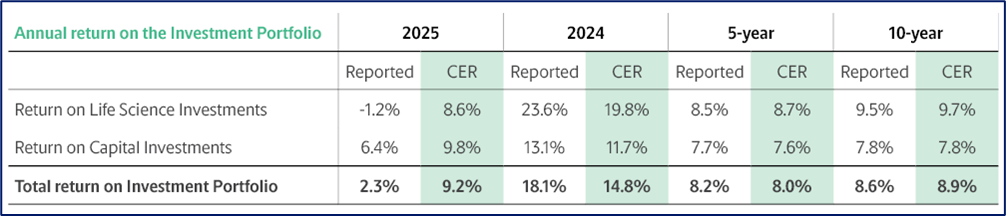
  • Novo Holdings generated returns on the Investment Portfolio2 of 2.3% in DKK, and 9.2% in Constant Exchange Rates (CER). The return for 2024 in CER was 14.8%.
  • Novo Holdings’ 5- and 10-year returns are at 8.0% and 8.9%, respectively, in CER and stand well above benchmark.
  • Total Income and Returns were negatively affected by the lack of proceeds from a share buyback from Novo Nordisk A/S (Novo Nordisk A/S suspended its buyback in 2025), and the significant depreciation in the US Dollar.
  • Total Assets under Management amounted to DKK 694 billion (€93 billion) in 2025, down from DKK 1,060 billion (€142 billion) in 2024, primarily reflecting the significant drop in the market value of Novo Nordisk A/S. The Investment Portfolio grew from DKK 216 billion (€29 billion) in 2024 to DKK 226 billion (€30 billion) in 2025.

COPENHAGEN, Denmark, March 12, 2026 (GLOBE NEWSWIRE) — Novo Holdings today announced its financial results for 2025. The Novo Holdings Investment Portfolio continued to perform well on both an absolute and relative basis, with a return of 9.2% in CER. However, the depreciation of the US dollar by more than 11% against the Danish krone materially offset performance in Danish kroner.

Kasim Kutay, CEO of Novo Holdings, said: “We delivered a strong performance during the year, driven by, among other things, significant monetisations such as the exit of Clario and KabaFusion.3 This was achieved against a backdrop of considerable headwinds for the life sciences industry.”

Novo Holdings’ Investment Portfolio comprises Life Science Investments, the investment activities that are focused on human and planetary health, making up 52% of the total portfolio, and Capital Investments, making up the remaining 48% of the portfolio.

Activity across all Novo Holdings’ Life Science Investments teams remained high in 2025; however, there was a stronger emphasis on asset management and exits than on acquisitions. The Principal Investments Team announced the successful exits of both KabaFusion and Clario3 from the private portfolio and fully exited its public positions in Convatec and Evotec.

Novo Holdings deployed DKK 13 billion (€1.8 billion) into life sciences in 2025. In total, 12 new companies were welcomed to the Investment Portfolio, and several existing portfolio companies were supported by additional investments. During the year, Novo Holdings exited 36 companies, and the Investment Portfolio included 170 companies by year-end.

Life Science Investments closed the year with DKK 124 billion (€17 billion) of Investment Assets and generated a return of -0.3% in DKK and 9.8% in CER, corresponding to DKK -422 million (€-57 million).

Capital Investments provides global exposure beyond the life science sectors and is actively expanding and diversifying the total portfolio.

Capital Investments delivered a strong performance in 2025, outperforming benchmarks despite strong currency headwinds and a market heavily concentrated on technology and artificial intelligence (AI).
A strategy of providing global exposure beyond the life sciences sector by investing in less cyclical, resilient businesses with a high degree of recurring revenue, served Novo Holdings well throughout the year.

In 2025, Capital Investments closed the year with DKK 114 billion (€15 billion) of Investment Assets and had returns corresponding to DKK 6.2 billion (€0.8 billion). The Capital Investments Portfolio generated a return of 6.4% in DKK and 9.8% in CER.

Reflecting on a year marked by fundamental shifts within geopolitics, technology and the global investment environment, Kasim Kutay added:

“As a response to market volatility, we took a cautious approach to new investments in early 2025. Gradually, we picked up the pace which resulted in the addition of 12 new portfolio companies. Given the extreme volatility we experienced in parts of the market, I am pleased with the strong 9.2% CER return Novo Holdings generated in 2025, which comes on the heels of a 14.8% CER return in 2024. Geographically, we strengthened our position in Asia by establishing a presence in Mumbai. With enhanced asset and geographic diversification in Novo Holdings’ Investment Portfolio, I believe we remain very well-positioned to continue delivering on our purpose of improving people’s health and the sustainability of society and the planet by generating attractive long-term returns for the Novo Nordisk Foundation.”

Learn more in the 2025 Performance Report

Annual return on the Investment Portfolio

About Novo Holdings A/S
Novo Holdings is a holding and investment company that is responsible for managing the assets and the wealth of the Novo Nordisk Foundation. The purpose of Novo Holdings is to improve people’s health and the sustainability of society and the planet by generating attractive long-term returns on the assets of the Novo Nordisk Foundation. Wholly owned by the Novo Nordisk Foundation, Novo Holdings is the controlling shareholder of Novo Nordisk and Novonesis and manages an investment portfolio with a long-term return perspective. In addition to managing a broad portfolio of equities, bonds, real estate, infrastructure and private equity assets, Novo Holdings is a world-leading life sciences investor. Through its Seed, Venture, Growth, Planetary Health Investments and Principal Investments teams, Novo Holdings invests in life science companies at all stages of development. As of year-end 2025, Novo Holdings had total assets of €93 billion.

About the Novo Nordisk Foundation
Established in Denmark in 1924, the Novo Nordisk Foundation is an enterprise foundation with philanthropic objectives. The vision of the Foundation is to improve people’s health and the sustainability of society and the planet. The Foundation’s mission is to progress research and innovation in the prevention and treatment of cardiometabolic and infectious diseases as well as to advance knowledge and solutions to support a green transformation of society.

Media enquiries
Marie-Louise Jersin, Senior Communications Lead, maj@novo.dk

___________________________

1 The Investment Assets Portfolio includes all our Investment Assets.

2 The Investment Portfolio excludes Special Investments, which comprise impact investments and Assets held for Novo Nordisk Foundation strategic purposes.

3 Both transactions signed in 2025 with KabaFusion closing in Q1 2026 and Clario expected to close in Q2 2026.

A photo accompanying this announcement is available at https://www.globenewswire.com/NewsRoom/AttachmentNg/3c9b5534-9cfc-4810-9a21-235b6c6575b9

BioVersys Announces First Patient Dosed in Phase 2b Clinical Trial of AlpE in Pulmonary Tuberculosis


Basel, Switzerland. March 12, 2026, 7am CET. 

  • Under the BioVersys and GSK collaboration agreement, AlpE clinical development advances with first patient dosed in Phase 2b trial within UNITE4TB, following completion of a Phase 2a in adults with drug-susceptible pulmonary TB (DS-TB) in combination with RZE.[1]
  • In the new Phase 2b trial in adults with DS-TB, AlpE will be dosed for two months together with RZE, patients then continue only with RH[2] for 18 weeks.
  • Phase 2b results are expected by the end of 2027.
  • In addition, BioVersys plans to initiate a Phase 2 trial in TB meningitis in H1 2026.


BioVersys AG (SIX: BIOV), a multi-asset, clinical stage biopharmaceutical company focusing on research and development of novel antibacterial products for serious life-threatening infections caused by multi-drug resistant (MDR) bacteria, announced today, that the first patient has been dosed in a  pulmonary TB Phase 2b clinical trial, evaluating the efficacy, safety and pharmacokinetics of alpibectir-ethionamide (AlpE) in combination with first-line TB drugs (NCT05807399).

In this new Phase 2b trial, a portion of the recruited adults with drug sensitive pulmonary tuberculosis (DS-TB) will be dosed for 2-months with RZE in combination with AlpE, followed by 18 weeks with RH alone, to assess efficacy, safety and pharmacokinetics of AlpE. The study is being conducted in six African countries under the European Union’s IMI2 UNITE4TB project, with the Institute of Infectious Diseases and Tropical Medicine, LMU University Hospital Munich as the trial sponsor. Through this Phase 2b TB drug combination trial, BioVersys and its partner GSK are progressing the development of this unique combination and taking the next step in terms of dose finding and potential positioning of AlpE in future TB drug regimens. This trial is expected to read-out by the end of 2027.

Preceding this Phase 2b trial, AlpE underwent a second Phase 2a trial in which AlpE was assessed over 14 days in an open-label trial in combination with first line TB drugs. Top-line data is expected to be available Q2 2026. AlpE was generally well tolerated in this trial, supporting the progression into Phase 2b. BioVersys also plans to initiate a Phase 2 trial in meningeal TB in H1 2026.

Alpibectir (previously known as BVL-GSK098) is a small molecule developed from BioVersys’ award winning Transcriptional Regulatory Inhibitory Compounds (TRIC) platform in a successful collaboration with GSK, the Institut Pasteur Lille and the University of Lille. AlpE’s development has been strongly supported by European Union and European Pharmaceutical Industry through Innovative Medicines Initiative (IMI2) Joint Undertaking, EDCTP and now UNITE4TB. The compound represents a novel concept to overcome resistance and potentiate the activity of an existing antibiotic, ethionamide (Eto) or prothionamide (Pto), for the treatment of TB, as demonstrated in a previous 7-day early bactericidal activity Phase 2a clinical trial, recently published in the New England Journal of Medicine,[3] which provided a first human proof-of-concept. In 2023, the fixed-dose combination of AlpE was granted orphan-drug designation (ODD) for the treatment of tuberculosis by the U.S. Food and Drug Administration (FDA), and similarly in 2025, AlpE was granted Orphan Designation from the European Medicines Agency (EMA).

Dr. Glenn E. Dale, Chief Development Officer of BioVersys: “Alpibectir consistently shows promise as a new therapeutic option in combination with ethionamide for addressing tuberculosis. It’s considered to be generally well tolerated with a promising safety profile demonstrated across a number of Phase 1 and Phase 2 clinical trials, and has already demonstrated clinical proof of concept, with 7-day early bactericidal activity similar to isoniazid in patients with tuberculosis in a Phase 2a study. We are now excited to investigate AlpE in this longer clinical study, in combination with first-line TB drugs.”

Prof. Michael Hoelscher, Director, Institute of Infectious Diseases and Tropical Medicine and Principal Investigator of the STEP2C trial: “With the evaluation of alpibectir, UNITE4TB is testing its fifth novel drug candidate in its innovative Phase 2b regimen selection platform, where we evaluate how novel assets are best combined with other licensed or new drugs. This approach will help to derisk the chance of progressing the wrong combination into Phase 3. LMU Hospital is proud to be the sponsor of a trial for such a promising drug.“

David Barros-Aguirre Head of Global Health Medicines R&D, GSK and UNITE4TB Project Lead: “Tuberculosis (TB) remains a major public‑health threat, disproportionately affecting vulnerable communities in high‑burden countries. Advancing alpibectir‑ethionamide (AlpE) into a Phase 2b trial, in combination with first‑line TB drugs, represents an important step in addressing isoniazid resistance and evaluating the potential of this combination for the treatment of other forms of drug‑resistant TB. Through our longstanding partnership with BioVersys and UNITE4TB, we remain committed to changing the trajectory of the TB epidemic.”

Dr. Marc Gitzinger, Chief Executive Officer of BioVersys: “We are grateful to all our partners for their support of the clinical development of AlpE for TB patients. The unique clinical trial platform, UNITE4TB, provides the ideal opportunity to investigate AlpE’s potential benefit for TB patients. UNITE4TB is a landmark EU IHI program public and private partnership setting new standards in TB drug development and future regimen finding. We are excited to include AlpE in this program and investigate it alongside other novel assets with the potential to transform the future care for TB patients.”


About tuberculosis (TB)

Tuberculosis (TB) remains one of the leading causes of death worldwide. It is caused by the bacterial pathogen Mycobacterium tuberculosis (Mtb). According to the WHO Global Tuberculosis Report 2025, an estimated 10.7 million people developed TB in 2024, and approximately 1.23 million died from TB.

Drug resistance continues to pose a major challenge. There were about 390,000 people who developed rifampicin-resistant TB (RR-TB) or multidrug-resistant TB (MDR-TB) in 2024. MDR-TB remains a public health crisis and a health security threat, with global treatment success rates at only 71%.

The major burden of TB is concentrated within 30 high TB burden countries, accounting for 87% of the global total in 2024. Of those, the top eight countries for TB cases worldwide were, India (25%), Indonesia (10%), the Philippines (6.8%), China (6.5%), Pakistan (6.3%), Nigeria (4.8%), the Democratic Republic of the Congo (3.9%) and Bangladesh (3.6%). Globally, 8.3 million people were reported as newly diagnosed with TB in 2024, Significantly, it remains that 3.2% of new TB cases and 16% of previously treated cases are MDR/RR-TB.


About Alpibectir

Alpibectir (previously known as BVL-GSK098) is a small molecule developed from BioVersys’ award winning Transcriptional Regulatory Inhibitory Compounds (TRIC) platform in a successful collaboration with GSK, the Institut Pasteur Lille and the University of Lille. Alpibectir acts through a novel mode of action, potentiating the activity of the anti-TB drug ethionamide (Eto). Alpibectir is being studied for its potential to, lower the efficacious human dose of Eto, minimizing of dose-dependent side effects, and overcome Eto resistance. The combination alpibectir/Eto (AlpE) is being developed for the treatment of pulmonary TB and TB meningitis. In 2023 AlpE was granted orphan-drug designation (ODD) for the treatment of tuberculosis, by the U.S. Food and Drug Administration (U.S. FDA) providing for certain incentives including seven years US market exclusivity. Similarly in 2025, AlpE was granted Orphan Designation from the European Medicines Agency (EMA), providing for certain incentives including 10-year EU market exclusivity.


About UNITE4TB

UNITE4TB is one of nine projects within the AMR Accelerator. Working across a global clinical trials network, UNITE4TB conducts regulatory standard Phase 2 clinical trials to accelerate clinical evaluation of novel drugs and combinations of drugs for tuberculosis (TB). Innovative adaptive trial designs, treatment response biomarkers, pharmacokinetic-pharmacodynamic models and Artificial Intelligence / Deep Learning techniques are integrated across study protocols, deploying cutting-edge methodologies to find antibiotic regimens with the highest likelihood of improved clinical efficacy.


This project has received funding from the Innovative Medicines Initiative 2 Joint Undertaking (JU) under grant agreement No 101007873. The JU receives support from the European Union’s Horizon 2020 research and innovation programme and EFPIA, Deutsches Zentrum für Infektionsforschung e. V. (DZIF), and Ludwig-Maximilians-Universität München (LMU). EFPIA/AP contribute 50% of funding, whereas the contribution of DZIF and the LMU University Hospital Munich has been granted by the German Federal Ministry of Education and Research.


About the Innovative Medicines Initiative

The Innovative Medicines Initiative (IMI) IMI is a partnership between the European Union and the European pharmaceutical industry, represented by the European Federation of Pharmaceutical Industries and Associations (EFPIA). It was set up to improve health by speeding up the development of, and patient access to, the next generation of medicines, particularly in areas where there is an unmet medical or social need. It works by facilitating collaboration between the key players involved in healthcare research, including universities, pharmaceutical companies, other companies active in healthcare research, small and medium-sized enterprises (SMEs), patient organisations, and medicines regulators. This approach has proven highly successful, and IMI projects are delivering exciting results that are helping to advance the development of urgently-needed new treatments in diverse areas. IMI projects are now managed by the Innovative Health Initiative (IHI), which builds on the successes of IMI and is a cross-sectoral public-private partnership involving a wider range of health industries.

About BioVersys

BioVersys AG is a multi-asset, clinical stage biopharmaceutical company focused on identifying, developing and commercializing novel antibacterial products for serious life-threatening infections caused by multi-drug resistant (“MDR”) bacteria. Derived from the company’s two internal technology platforms (TRIC and Ansamycin Chemistry), candidates are designed and developed to overcome resistance mechanisms, block virulence production and directly affect the pathogenesis of harmful bacteria towards the identification of new treatment options in the antimicrobial and microbiome fields. This enables BioVersys to address the high unmet medical need for new treatments against life-threatening resistant bacterial infections and bacteria-exacerbated chronic inflammatory microbiome disorders. The company’s most advanced research and development programs address nosocomial infections of Acinetobacter baumannii (BV100, Phase 3 ready), and tuberculosis (alpibectir, Phase 2a, in collaboration with GlaxoSmithKline (GSK) and a consortium of the University of Lille, France). BioVersys is located in the biotech hub of Basel, Switzerland.


BioVersys contact

Hernan Levett, CFO, Tel. +41 61 633 22 50; Mail: Hernan.levett@bioversys.com

For Media: media@bioversys.com

www.bioversys.com


This communication reflects the author’s view. Neither IHI nor the European Union, EFPIA, or any Associated Partners are responsible for any use that may be made of the information contained therein.


Disclaimer

This communication expressly or implicitly contains certain forward-looking statements, such as “believe”, “assume”, “expect”, “forecast”, “project”, “may”, “could”, “might”, “will” or similar expressions concerning BioVersys and its business, including with respect to the progress, timing and completion of research, development and clinical studies for product candidates. Such statements involve certain known and unknown risks, uncertainties and other factors, which could cause the actual results, financial condition, performance or achievements of BioVersys to be materially different from any future results, performance or achievements expressed or implied by such forward-looking statements. BioVersys is providing this communication as of this date and does not undertake to update any forward-looking statements contained herein as a result of new information, future events or otherwise.


[1] RZE in TB treatment refers to rifampicin (R), pyrazinamide (Z) and ethambutol (E), key first-line drugs in standard therapy for DS-TB.

[2] RH in TB treatment refers to rifampicin (R) and isoniazid (H), key first-line drugs in standard therapy for DS-TB.

[3]The Revival of Ethionamide by Alpibectir (BVL-GSK098), Michel Pieren et al, 2026; https://www.nejm.org/doi/full/10.1056/NEJMc2504287

MindMaze Therapeutics Appoints HealthTech Veteran Zach Henderson as CEO to Accelerate Global Commercial Scale

MindMaze Therapeutics Holding SA / Key word(s): Personnel

MindMaze Therapeutics Appoints HealthTech Veteran Zach Henderson as CEO to Accelerate Global Commercial Scale

12-March-2026 / 07:00 CET/CEST

Release of an ad hoc announcement pursuant to Art. 53 LR

The issuer is solely responsible for the content of this announcement.


MindMaze Therapeutics Appoints HealthTech Veteran Zach Henderson as CEO to Accelerate Global Commercial Scale

Former Rune Labs and Glooko executive to lead MindMaze’s next phase of growth, focusing on U.S. market expansion and the delivery of scalable, AI-driven neurorestorative care.

Geneva, Switzerland – March 12, 2026 – MindMaze Therapeutics Holding SA (SIX: MMTX) (MindMaze Therapeutics, or the Company), a global leader in brain technology and precision neurotherapeutics, today announced the appointment of Zach Henderson as Chief Executive Officer. Mr. Henderson joins at a pivotal inflection point as the Company invests in scaling its existing commercial presence, focused on accelerating adoption of its FDA-cleared platform in the United States to address the widening supply-demand gap in neurological care.

With over 30 years of experience, Mr. Henderson has a proven track record of scaling healthcare technology platforms and driving significant recurring revenue growth. His most recent role as Chief Commercial Officer at Rune Labs and his prior tenure as CEO of PKG Health underscore his expertise in commercializing AI-driven solutions for complex chronic conditions like Parkinson’s.

“MindMaze has built the industry’s most rigorous clinical foundation. Our mission now is to translate that scientific leadership into widespread market adoption,” said Walid Hanna, Chairman of the Board. “Zach’s operational depth and success across global markets make him the ideal leader to drive our commercial expansion and deliver value to our shareholders.”

The global healthcare system faces a critical shortage of neurologists and specialized therapists (PT/OT), leaving millions of patients with stroke, Parkinson’s disease, and Alzheimer’s with insufficient access to recovery. MindMaze is redefining this paradigm by shifting care from episodic, clinic-bound sessions to continuous, data-driven neurorestoration accessible at scale in both clinical and home settings.

“I am honored to lead MindMaze as we solve one of healthcare’s most pressing capacity challenges,” said Zach Henderson. “By digitizing the neuro-restorative journey, we are providing a scalable solution to a global shortage of specialized care providers. We are redefining the standard of care for tens of millions of patients worldwide.”

Mr. Alexandre Capet has been appointed Chief Operating and Strategy Officer continuing his service as a standing member of the Company’s Executive Committee.

About MindMaze Therapeutics
MindMaze Therapeutics (SIX: MMTX) is a global leader in brain technology, dedicated to redefining the recovery trajectory for patients with neurological platform-based digital treatments. By integrating advanced software, proprietary sensors, and AI-driven data analytics, MindMaze Therapeutics provides a seamless continuum of care from the acute hospital phase to outpatient treatment to the home-based therapy. The Company’s FDA-cleared and CE-marked neurotherapeutics are designed to address the systemic shortage of specialized clinicians, offering scalable, reimbursable solutions for stroke, Parkinson’s disease, and other brain disorders. With a commitment to rigorous clinical validation and a robust R&D pipeline, MindMaze Therapeutics is operationalizing the future of neurorestorative medicine.

For more information, visit www.mindmazetherapeutics.com.

Media & Investor Contacts
Investor Relations:

Jeremy Meinen, Chief Financial Officer
ir@mindmazetherapeutics.com
Media Inquiries:
VSC for MindMaze Therapeutics
mindmazetherapeutics@vsc.com 

DISCLAIMER
This press release contains forward-looking statements, which may be identified by words such as “believe,” “assume,” “expect,” “intend,” “may,” “could,” “will,” or similar expressions. These statements are based on current plans and assumptions and are subject to risks and uncertainties that could cause actual results, financial condition, performance, or achievements to differ materially from those expressed or implied. Such factors include, among others, business, economic, financial, regulatory, and competitive factors, as well as the Company’s ability to execute its strategy. This communication is provided as of the date hereof, and MindMaze Therapeutics undertakes no obligation to update any forward-looking statements contained herein as a result of new information, future events or otherwise.

Additional features:

File: Ad hoc release_MindMaze_CEO Appointment


End of Inside Information


Language: English
Company: MindMaze Therapeutics Holding SA
Avenue de Secheron 15
1202 Geneva
Switzerland
Phone: +41 22 545 11 16
Fax: +41 22 545 11 17
E-mail: contact@relieftherapeutics.com
Internet: www.mindmazetherapeutics.com
ISIN: CH1251125998
Listed: SIX Swiss Exchange
EQS News ID: 2290004

 
End of Announcement EQS News Service

2290004  12-March-2026 CET/CEST